 PropPilot.ai
AI vendors promise a lot. Skeptics say it is all smoke. Who is right? Neither — the data is. And the most comprehensive data available today on AI in real estate comes from Deloitte’s report RE-generative AI.
The report focuses on commercial real estate (offices, industrial, logistics), but its macro data applies across the sector. Here, we break it down and analyze what it means for residential real estate — where the opportunity is greatest and adoption is lowest.
$7.2 billion: the money has already spoken
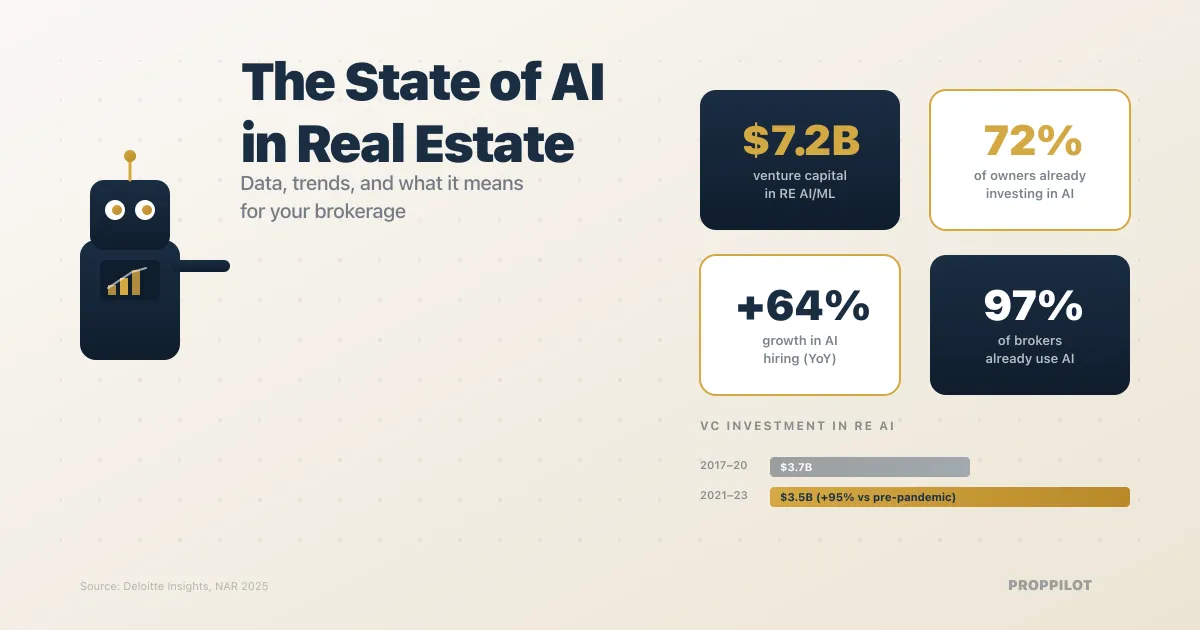
Since 2017, AI companies serving the real estate sector have raised $7.2 billion in venture capital. But the most revealing data point is not the total — it is the acceleration:
| Period | Investment | Context |
|---|---|---|
| 2017–2020 | ~$3.7B | Early years, exploratory adoption |
| 2021–2023 | $3.5B | Post-GenAI, concentrated investment |
In just three years (2021–2023), nearly as much was invested as in the previous four. And the 2023 pace exceeded pre-pandemic levels by 95%.
This is not hype. This is venture capital — money that demands returns — betting heavily on real estate AI as a category.
72% of owners and investors: demand from the top
Deloitte surveyed real estate owners and investors globally. The result: 72% are already allocating or planning to allocate resources to AI-enabled solutions. We are not talking about enthusiastic startups. We are talking about funds, asset managers, and major developers.
This matters because it represents institutional demand. When the people who buy and manage assets ask for AI, the rest of the chain — brokerages, agents, servicers — will adopt by competitive pressure. Not by conviction, but because their clients and partners will expect it.
Where is the money going? Deloitte’s map
The report breaks down the areas of highest investment and hiring:
By direct investment
| Area | % of total |
|---|---|
| Listings and transactions | 42% |
| Investment and valuation | 20% |
| Data analytics | 8% |
By AI talent hiring
| Function | % of postings |
|---|---|
| Architectural design | 34% |
| Construction/project management | 18% |
| Legal due diligence | 17% |
| HR/talent | 13% |
| Property management | ~20% |
The takeaway for residential is clear: 42% of investment goes to listings and transactions — exactly the ground where brokerages and developers operate. The money is flowing into the core of the residential business, not the periphery.
+64% in hiring: the talent race has begun
Job postings requiring generative AI skills in real estate grew 64% in 2022 and another 58% in 2023. That is sustained double-digit growth in a sector historically slow to digitize.
What does it mean? The most competitive firms are already building teams with AI capabilities. Not as a pilot project, but as an operational function. Those that do not will compete at a structural disadvantage — not a temporary one.
60%+ still on legacy technology
Here is the paradox in the report: while 72% plan to invest in AI, over 60% of surveyed firms admit to relying on legacy technology and facing adoption challenges.
This confirms what we see daily in the UAE and European markets: the intent is there, but execution lags far behind. The gap between “we want AI” and “we have AI working” is enormous. And that gap is exactly where competitive advantage is created for those who move first.
From commercial to residential: the opportunity Deloitte does not cover
Deloitte’s report centers on CRE (commercial real estate): offices, industrial, logistics, retail. The use cases it analyzes — asset valuation, due diligence, architectural design — belong to that segment.
But one data point connects directly to residential: sales management is where the most investment is concentrated (42%), and it is precisely in residential sales where inefficiency is greatest.
In commercial, a deal involves professional teams, months of due diligence, and contracts worth millions. In residential, the challenge is different: massive lead volume, individual conversations, short decision windows, and response times measured in minutes. It is an operational problem, not a financial one — and it is exactly the type of problem that agentic AI solves best.
If you want to understand how agentic AI addresses that challenge, we explore the topic in depth in our series on agentic AI in real estate.
Four questions the report leaves open
Deloitte presents the data but does not answer everything. These are the four questions the report leaves pending — and they are the most relevant for a residential brokerage:
1. How much of that investment reaches residential?
The report does not break down commercial vs. residential. But we know that 42% goes to listings and transactions, and that residential generates more transaction volume than commercial in every market. The share is likely significant, though invisible in the data.
2. What ROI are early adopters seeing?
Deloitte covers investment intent but not outcomes. For concrete ROI data in residential AI sales, the strongest reference is Lais.ai in Brazil, with a 54% improvement in conversion across 1,000+ clients.
3. How do you measure AI success in real estate sales?
The answer is not in vanity metrics (messages sent, conversations handled) but in business indicators. We analyze this in detail in our article on metrics that matter in agentic AI.
4. What about regulation?
Deloitte mentions data governance but does not cover regional regulation. For the European market, the EU AI Act is relevant — we analyze its implications for real estate in a dedicated article (Spanish only, as the regulation applies primarily to the EU market).
Conclusion: the data says the train has left the station
$7.2 billion in investment. 72% of owners committed. 64% growth in AI hiring. And 60%+ of the industry stuck on legacy technology.
The pattern is clear: money and talent are moving toward real estate AI, but most firms have not moved yet. That asymmetry is temporary. And the window to position as an early adopter closes a little more each quarter.
Want to know how your brokerage responds compared to those already using AI? Try our free Mystery Shopper: we analyze your team’s response to a real lead and give you a report with concrete data.