 PropPilot.ai
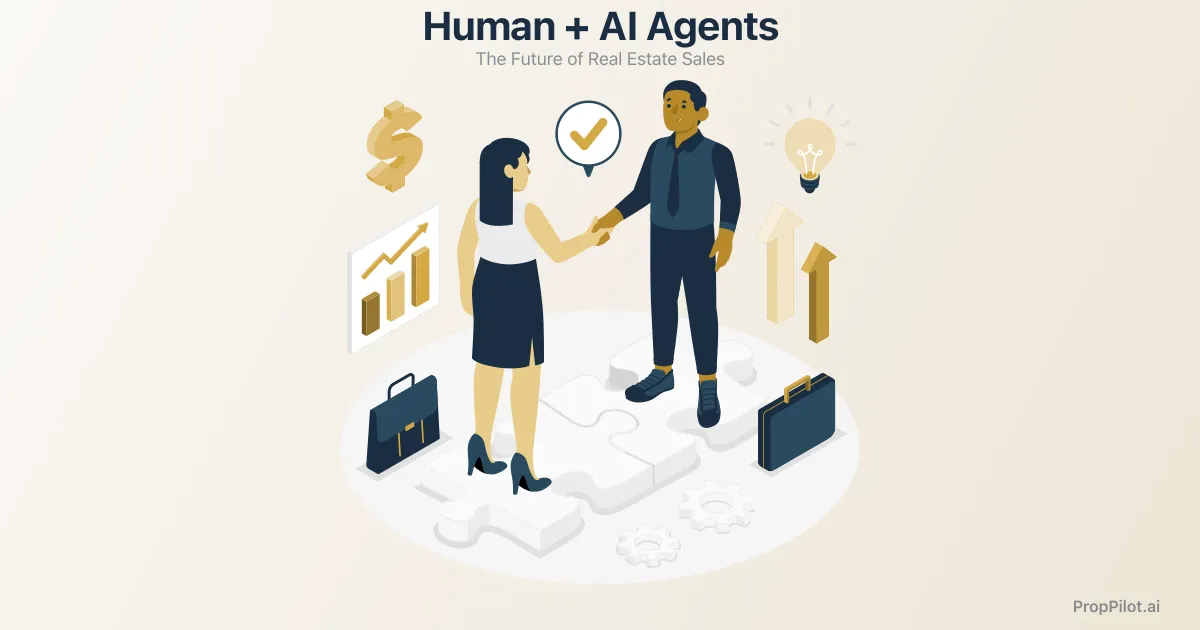
Every time a new technology emerges, the headline writes itself: “AI Will Replace Real Estate Agents.” It’s a headline that gets clicks, but it doesn’t survive scrutiny. After months of exploring agentic AI in this series, we’ve arrived at the central point of the entire conversation: the future isn’t AI vs. humans. It’s AI with humans.
In this final article of the series, we’ll dismantle the replacement narrative, define the new collaboration model, and map out what’s coming for real estate agencies across the UAE and beyond.
The False Narrative: “AI Will Replace Real Estate Agents”
It’s tempting to believe. Agentic AI systems can already respond to leads at 3 AM, qualify prospects without human intervention, and manage follow-ups for weeks without missing a single contact. If AI can do all that, why would we need a flesh-and-blood agent?
The answer is straightforward: because buying property isn’t like booking a flight online.
A real estate transaction is, by far, the most significant financial decision most people make. It involves deep emotions, complex negotiations, local knowledge that lives in no database, and above all, trust. Trust cannot be automated.
What can be automated is everything that surrounds that trust: response speed, follow-up consistency, data preparation, and document management. That’s where agentic AI enters the picture — not as a replacement, but as the best tool a real estate agent has ever had.
What’s Really Happening: A New Division of Labour
The model emerging in 2026 doesn’t eliminate the human agent. It liberates them. It removes the repetitive tasks that consume 60-70% of their day and lets them focus on what truly generates value: relationships, negotiation, and closing.
Think of it like a Formula 1 team. The driver (human agent) doesn’t change tyres or analyse telemetry in real time. That’s the pit crew’s job (AI agent). But without the driver, the car doesn’t win the race.
The Human Agent’s Evolved Role
The real estate agent of 2026 isn’t the same as 2020. Their role has elevated:
- Relationship builder: Property purchase is emotional. The human agent understands fears, aspirations, and family context in ways no AI can replicate.
- Expert negotiator: Real estate negotiations require reading body language, detecting subtle signals, and adapting strategy in real time.
- Trusted adviser: Buyers need someone who will say “this community isn’t right for you, here’s why” with honesty and local insight.
- Local expert: Knowing that a particular tower has ongoing maintenance issues, that a new metro line will increase values in a specific area, or that a developer has a track record of delayed handovers — that knowledge isn’t in any dataset.
- Problem solver: When legal, financial, or emotional complications arise, the human agent is the one who unblocks the deal.
The AI Agent’s Role
The AI agent complements the human in everything the machine does better:
- 24/7 availability: Leads don’t respect office hours. AI responds in seconds, any time, any day — crucial in Dubai where enquiries come from every time zone.
- Data processing: Analysing comparables, market trends, and yields in seconds rather than hours.
- Follow-up consistency: No lead goes uncontacted. Every follow-up happens at the optimal moment, with the right message.
- Documentation: Automated preparation of property briefs, market reports, and pre-transaction documentation.
- Objective qualification: Evaluating purchase intent, financial capacity, and urgency without bias or assumptions.
The Collaboration Model: Who Does What
| Task | Human Agent | AI Agent |
|---|---|---|
| First response to lead (< 2 min) | x | |
| Initial qualification | x | |
| In-depth discovery call | x | |
| Data-driven property recommendations | x | |
| In-person viewing / personalised video call | x | |
| Automated post-viewing follow-up | x | |
| Price and terms negotiation | x | |
| Comparable analysis and market reports | x | |
| Emotional management of buyer/seller | x | |
| Documentation and reminders | x | |
| Deal closing | x | |
| Satisfaction survey and post-sale nurturing | x |
The pattern is clear: AI manages the process; the human manages the relationship.
Three Scenarios of Human + AI Collaboration
Scenario 1: Lead at Midnight
It’s 00:47. A potential buyer from London submits an enquiry on a Dubai Marina apartment after browsing Property Finder. In the traditional model, that lead would wait until morning — or until Sunday. By then, they’ve already contacted three other agencies.
With agentic AI:
- 00:47 — AI responds via WhatsApp in 12 seconds. Asks three qualification questions.
- 00:52 — The lead confirms: looking for a 2-bed in Dubai Marina, budget AED 2.5M, mortgage pre-approved, planning to relocate in Q3. AI classifies them as a hot lead.
- 00:55 — AI sends three matching properties and schedules a video call for the next morning.
- 09:00 — The human agent receives a complete briefing: lead profile, responses, suggested properties, browsing history.
- 10:00 — The human agent conducts the video call fully prepared. Books an in-person viewing for the following day.
Result: The lead was attended in 12 seconds. The human agent started their day with a confirmed, high-quality appointment.
Scenario 2: Complex Negotiation
A seller wants to list their Palm Jumeirah villa at AED 25 million. The market tells a different story.
- AI prepares in 30 seconds a report with 15 comparable sales from the last 6 months, price trends for the sub-community, average days on market by price range, and an optimal pricing estimate.
- The human agent sits down with the seller, presents the data, and has the difficult conversation: “I understand what this property means to you, but the data shows the market for this configuration is at AED 20-22M. If we list at 25M, we’ll sit for 6 months with no serious offers and end up reducing. I recommend listing at AED 22M with room to negotiate to 21M.”
AI provided the data. The human provided the empathy, honesty, and experience to get the seller’s agreement.
Scenario 3: Portfolio Investor
An investor holds 50 properties across Dubai, Abu Dhabi, and Ras Al Khaimah. They want to optimise their portfolio: sell underperformers and reinvest.
- AI monitors all 50 properties continuously: yields, occupancy rates, comparable market values, area trends.
- Each month it generates an automated executive report with alerts: “The unit in JVC has appreciated 14% in the past year. Optimal selling window within the next 3 months based on seasonal demand patterns.”
- The human agent meets quarterly with the investor to review strategy, discuss AI recommendations, and make joint decisions.
No AI can replace the strategic meeting with an investor. But no human can monitor 50 properties across three emirates with that level of granularity.
The Skills That Matter in 2026+
If you’re a real estate agent, these are the competencies you should be developing:
- Advanced emotional intelligence: The more transactional work gets automated, the more valuable relational skills become. Empathy is your primary competitive advantage.
- Data interpretation: You don’t need to be a data analyst, but you must understand the reports AI generates and translate them into actionable recommendations for your clients.
- Strategic negotiation: With better data available to all parties, negotiations will become more sophisticated. Agents who master data-driven negotiation will win.
- Technology management: Knowing how to configure, supervise, and optimise your AI agent will be as fundamental as knowing how to use a CRM today.
- Personal brand and content: In a world where AI manages the process, clients will choose their agent based on reputation, local knowledge, and digital presence.
What Agencies Should Do NOW
There’s no need to wait until 2027. Agencies preparing today will have an enormous advantage:
- Audit your current sales process: How much time do your agents spend on repetitive tasks? That’s the immediate ROI of agentic AI.
- Implement intelligent auto-response: The single most impactful first step. As we explored in our article on response time, the first 5 minutes determine conversion.
- Train the team, don’t replace it: The most profitable investment is upskilling current agents to work with AI, not substituting them with AI.
- Measure what matters: As we discussed in the previous article on metrics, you need the right KPIs to manage a human+AI team effectively.
- Mystery shop your own operation: Before changing anything, understand how you respond today. Request a free Mystery Shopper audit and get a real diagnosis.
Predictions for 2027-2030
Based on current trends, here’s what we foresee:
2027: The majority of mid-size agencies in the UAE will have adopted some form of AI in lead management. Those that haven’t will start losing market share visibly.
2028: The role of “AI operations manager” will appear as a specific position in larger brokerages. Agents working with AI will close twice the deals of those working without it.
2029: Property portals will integrate agentic AI as a standard feature in their premium packages. The differentiator will no longer be “having AI” but “how well your AI works with your human team.”
2030: The real estate agent who relies solely on cold calls and manual follow-up will be as rare as one who doesn’t use a mobile phone today. Human+AI collaboration will simply be “how things are done.”
The Future Is Already Here
We’re not talking about science fiction. The technology exists today. AI agents are already responding to leads, qualifying prospects, and preparing data for human agents at developers and agencies across the UAE.
The question isn’t whether AI will change real estate sales. The question is whether you’ll be among those leading the change or those reacting to it.
Want to see how your team responds today compared to market standards? Request a free Mystery Shopper audit and discover your starting point.
Complete Series Reading Path: Agentic AI in Real Estate
You’ve reached the end of our series on agentic AI in real estate. Here’s the complete reading path in case you’d like to revisit any article or share it with your team:
- Agentic AI in Real Estate: What It Is and Why 2026 Is the Tipping Point — The foundations: what agentic AI is and why it’s different from everything before it.
- Metrics That Matter: How to Measure Agentic AI Performance in Real Estate — The KPIs you need to manage a human+AI team effectively.
- The Future of Real Estate Sales: Human Agents + AI Agents (this article) — The collaboration model that will define the next decade of the industry.
Ready to start? Go back to the first article in the series and share the complete reading path with your team.