 PropPilot.ai
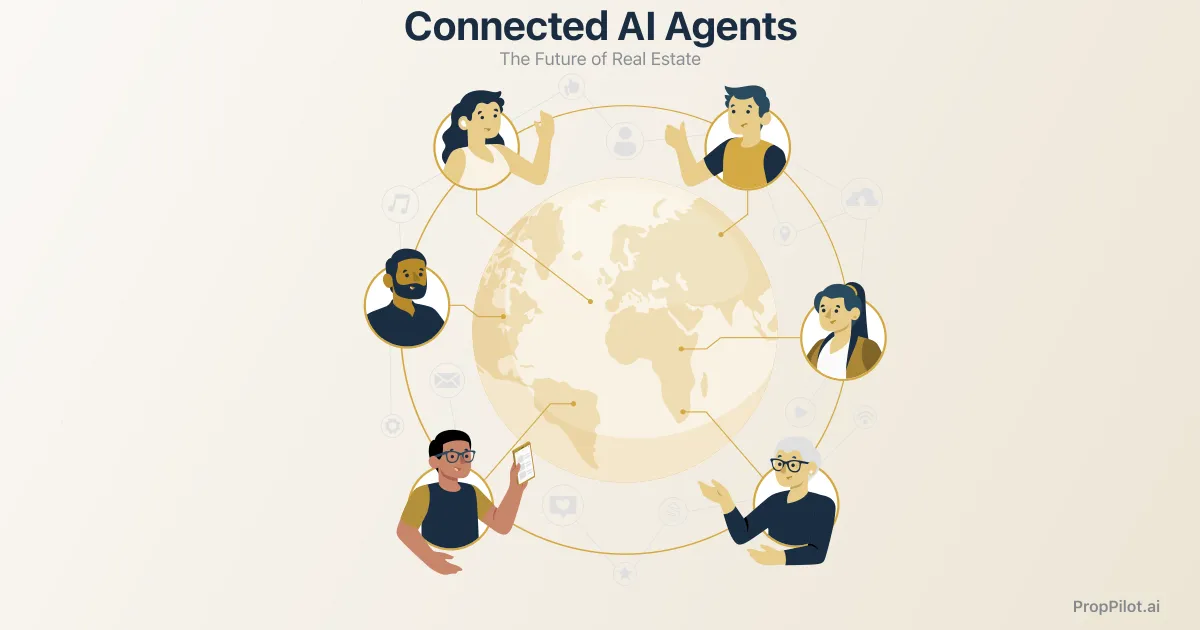
The problem: AI tools that don’t talk to each other
If you’ve started using AI in your brokerage — a chatbot that responds to leads, a system that generates property descriptions, a tool that analyzes market prices — you’ve probably noticed something: each tool operates in its own bubble.
Your chatbot qualifies a lead but can’t book a viewing in your calendar. Your content generator creates perfect descriptions but doesn’t know which properties are active in your CRM. Your pricing tool generates reports but can’t automatically send them to the client who needs them.
It’s like having a team of five excellent people who don’t talk to each other.
Two ways to solve it
There are two paths from disconnected tools to an intelligent system:
Path 1: An integrated platform that orchestrates the full workflow
Instead of connecting 5 separate tools, an agentic platform manages the entire workflow natively: qualifies, searches properties, sends documentation, books viewings, and follows up — all within a single system where context flows automatically between each step.
The advantage is immediate: no data to copy between tools, no integrations to maintain, and the AI has full client context at every moment.
Path 2: Connect specialized tools via open standards
The AI industry is creating interoperability standards so that different tools can communicate with each other, even when they’re built by different companies.
The reality: you need both
The most powerful scenario combines both strategies: a smart central platform that manages the sales workflow end to end, connected to your existing stack (CRM, WhatsApp Business, calendar, property portals) via open standards.
This way, the AI doesn’t operate on an island — it integrates into your real ecosystem.
The standards making connection possible
These are the most relevant protocols emerging:
MCP (Model Context Protocol)
Developed by Anthropic (the creators of Claude), MCP is a standard that allows AI models to connect with tools and data sources universally. Instead of building a custom integration for every service, an MCP-enabled system can access calendars, CRMs, databases, and APIs using a common protocol.
Think of it as going from needing a different adapter for every plug to having a universal socket.
Agent Connect Protocol (ACP)
Part of the AGNTCY initiative, ACP allows AI systems built with different technologies to communicate directly with each other. A lead qualification system can coordinate with a scheduling system without a human needing to copy data from one to the other.
Open Agentic Schema Framework (OASF)
Think of OASF as a “passport” for AI systems. It defines a standard format for each system to describe what it can do, what data it needs, and how to communicate with it. This enables “directories” where a system can automatically find the right tool for each task.
What this means for a real estate brokerage
Let’s leave the theory behind. Here’s what it looks like in practice:
Scenario: A lead comes in at 10 PM on a Thursday
Today (disconnected tools):
- The chatbot responds and qualifies → saves data in its own system
- Next morning, an agent sees the lead in the CRM and manually searches for properties
- Sends an email with a brochure generated from another tool
- Tries to book a viewing via WhatsApp
- If the lead is international, looks for a colleague who speaks their language
With an integrated, connected agentic system:
- The AI chats with the lead and identifies they’re looking for a 3-bedroom property on the coast, budget of €400K, 6-month timeline
- Cross-references criteria with active inventory and selects 3 properties — all within the same conversation context
- Generates and sends a personalized brochure with the 3 properties, including area price comparisons
- Checks availability of the most suitable sales agent (by language and area) and proposes times to the lead
- Schedules a follow-up 48 hours before the viewing and a post-viewing check-in
All of this happens in minutes. The sales agent arrives the next morning with a booked viewing, a qualified lead, and a personalized brochure.
The key isn’t just speed — it’s shared context
What’s truly powerful isn’t that the AI is fast, but that it maintains full context at every step. When it books the viewing, it knows exactly what the lead said in the conversation. When it generates the brochure, it knows the lead asked about nearby schools and prioritizes that information.
This is possible because the entire workflow happens within a system that shares context natively — not because someone connected 5 tools with digital duct tape.
Why open standards matter (even with integrated platforms)
If a platform already manages the full workflow, why do you need open standards?
Because no platform operates in a vacuum. Your brokerage already uses a CRM, an invoicing system, property portals, WhatsApp Business, Google Calendar… The AI needs to connect with all of that.
Open standards like MCP matter because they:
- Connect the AI with your existing stack without custom integrations that break
- Prevent total dependency on a single vendor for everything
- Enable evolution — if you switch CRMs tomorrow, the connection adapts without rebuilding the system
- Reduce integration costs by 40-60% according to industry estimates
The question isn’t “integrated platform OR open standards.” It’s: does your integrated platform speak the same language as the rest of your tools?
How to choose future-ready solutions
When evaluating AI tools for your brokerage, these questions will help:
- Does it manage the full workflow? From the first lead response to post-viewing follow-up, without jumping between tools
- Does it share context across functions? If it qualifies a lead, is that information automatically available when booking viewings or sending documentation?
- Does it connect to your current stack? CRM, WhatsApp Business, calendar, property portals
- Is it built on open standards? Ask if it uses MCP or other interoperability protocols
- Can you integrate new tools? If you need to connect a new portal or digital signature system tomorrow, is it possible without rebuilding everything?
What’s next: from smart systems to autonomous ecosystems
The evolution is clear:
- 2024-2025: Individual AI tools (chatbots, text generators, analytics)
- 2026: Integrated agentic platforms that connect to your stack via open standards (where we are now)
- 2027+: Complete ecosystems where systems discover each other, negotiate tasks, and self-orchestrate
For real estate, this means the brokerage of the future won’t be the one with the most tech tools or the most expensive AI. It will be the one with the smartest system, best connected to its real operations.
Conclusion
Having disconnected AI tools is like hiring the world’s best professionals and putting them in offices with no phone or email. The technology to integrate everything into one intelligent workflow already exists. The open standards to connect that workflow with the rest of your business are consolidating.
The question isn’t whether your AI should manage the full sales workflow. It’s how much longer you’ll spend copying data between tools while your competition doesn’t.
Want to see how an integrated agentic system works in practice? Try how PropPilot manages leads autonomously — from the first conversation to the booked viewing or download our free ebook on intelligent real estate lead response.